
2024-2025 Report

Introduction
The Texas Early Childhood Professional Development System (TECPDS) includes the Texas Workforce Registry, a web-based application that enables early childhood professionals to track their education and employment history, as well as the professional development they have accumulated throughout their careers. This State of the Texas Early Childhood Education Workforce Report compiles aggregate, statewide data from the Texas Workforce Registry to tell an extensive story about the Texas early childhood workforce. As the platform expands to serve more workforce members, the datasets within TECPDS have grown, enabling opportunities to define and describe these data stories.
The current data snapshot focuses on the education and experience of the three most common roles in the TECPDS: administrators, educators1, and trainers. Published by the Children’s Learning Institute, the data in this report were exported from TECPDS on December 5, 2025. We examined data for a statewide population of 120,476 early childhood professionals in TECPDS2 across various roles. This snapshot also looks at the data for a subpopulation of Texas Rising Star early learning programs, consisting of 26,520 (classroom staff who deliver and support instruction) and 5,043 administrators (program and school leaders).3
Recommended Use of Workforce Report Data
We encourage stakeholders across sectors to use the report to support data-driven decision-making and better understand the education and experience of the early childhood workforce. While TECPDS coverage continues to expand statewide, it does not yet include all early childhood professionals in Texas. Even so, the data presented in this report can provide valuable insight into the education and experience of a large and growing segment of the early childhood workforce and can be used to examine workforce characteristics, track growth over time, and explore potential impacts of early childhood initiatives. Users are encouraged to apply the report’s filtering tools to explore different role types, experience, and educational attainment data to observe differences, including regional variations. Although individual data displays may appear distinct, the measures are interrelated and should be interpreted in combination. For example, one cannot discuss educational attainment data without referencing experience, credentials, and other relevant factors.
Educational Attainment
In TECPDS, early childhood professionals document their educational attainment throughout their careers. Because the highest level of educational attainment is often associated with career advancement opportunities, it is a key field within a user’s profile. The dashboard below presents statewide and regional distributions of the highest level of education attained by professionals in TECPDS who work with children from birth through age 8.
While participation in TECPDS continues to expand statewide, the overall pattern is consistent with the national early childhood workforce profile: over half of the early educators have earned less than an associate’s degree, and two-thirds have earned less than a bachelor’s degree. These findings have remained stable across recent years of TECPDS reporting. These distributions are consistent with current Child Care Regulation requirements for a High School diploma or General Education Development Test (GED) to work in child care settings, and align with findings from recent Texas workforce surveys (2025 Texas Career Pathway Study4 and 2022 Texas Director Survey5.
For professionals with TECPDS accounts, this report categorizes users into three primary role groups: educators (most often serving in classroom-based roles), directors who lead early learning programs, and registered trainers who have applied and been approved on the Texas Trainer Registry, which is also hosted on TECPDS. As expected, roles with greater responsibility were associated with higher levels of reported educational attainment. For example, in 2025, 70% of administrators had at least some college education, while only 50% of educators did. Registered trainers, who are often viewed as experts in their fields, unsurprisingly report high levels of educational attainment: 86% of trainers on TECPDS hold at least a bachelor’s degree.
Looking specifically at credentials, approximately 2.4% of educators, 9% of administrators, and 6.6% of trainers report holding a Child Development Associate® (CDA) Credential, the most reported credential in TECPDS. The CDA provides an opportunity for competency development and career advancement outside of a traditional 2-4-year college degree. Available nationwide, the CDA can be a significant pathway to higher education, with many educators later articulating their CDA to pursue their associate’s degree or higher. The CDA must be renewed every three years, and users may not consistently update their CDA status in TECPDS. As a result, reported CDA counts may include expired credentials; for context, in 2025, only 36.6% of reported CDA are still active.
Across the overall labor market, earning a bachelor’s degree provides advantages, most notably improved earnings. However, recent national data indicate that higher educational attainment does not substantially increase wages within the child care sector6, ultimately providing little financial incentive (i.e., wages are constrained by market factors regardless of an educator’s educational attainment7). Additionally, educators may still benefit from higher levels of educational attainment when seeking other positions within the early childhood field.
Take some time to explore the education attainment filtering tool and see what you find! Use the filtering options to view data by role, education attainment, or Texas region.
Educational Attainment Data
Texas Rising Star Educational Attainment
Participation in the Texas Workforce Registry is not currently required for the early childhood field statewide, which contributes to missing data across TECPDS accounts. In 2020, however, using the Texas Workforce Registry became mandatory for administrators of early learning programs participating in Texas Rising Star, the state’s quality rating and improvement system for child care. Administrators were required to complete their personal profiles (including education, experience, and professional development) for assessment purposes, and educators’ use was strongly encouraged. As a result, TECPDS includes a subset of Texas Rising Star career data that is more complete and can provide a clearer basis for comparison across roles and programs. In 2025, TECPDS initiated a similar pilot project with Child Care Regulation that has since moved into implementation.
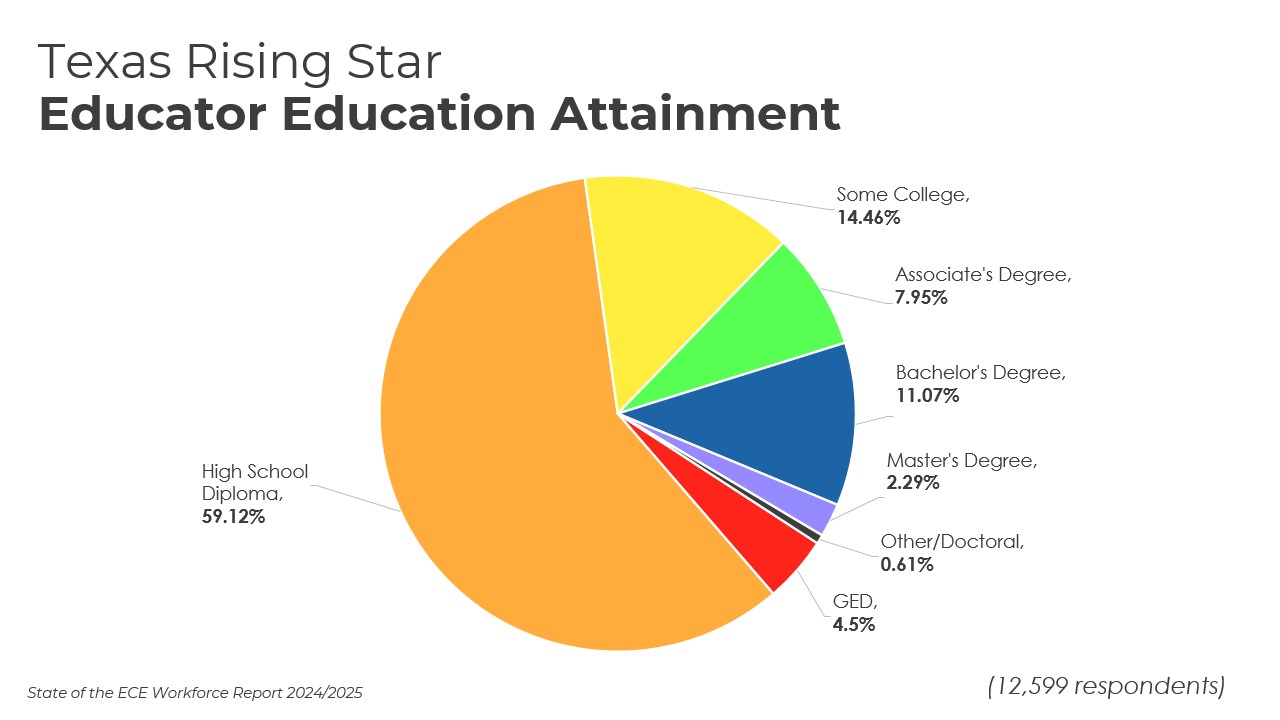
Although not all staff employed by Texas Rising Star-participating programs are required to upload their career records to TECPDS, participation among this group has increased over time, in part due to administrators’ recognition of the value of maintaining staff records in a single system. Within this more complete set of career data, three-quarters of Texas Rising Star educators (78%) have earned less than an associate’s degree. This pattern is consistent with prior years’ data; however, the proportion of educators reporting only a high school diploma or GED has increased. This shift may be related to changes in workforce composition, as the proportion of educators reporting fewer years of experience has also increased (see experience data below).
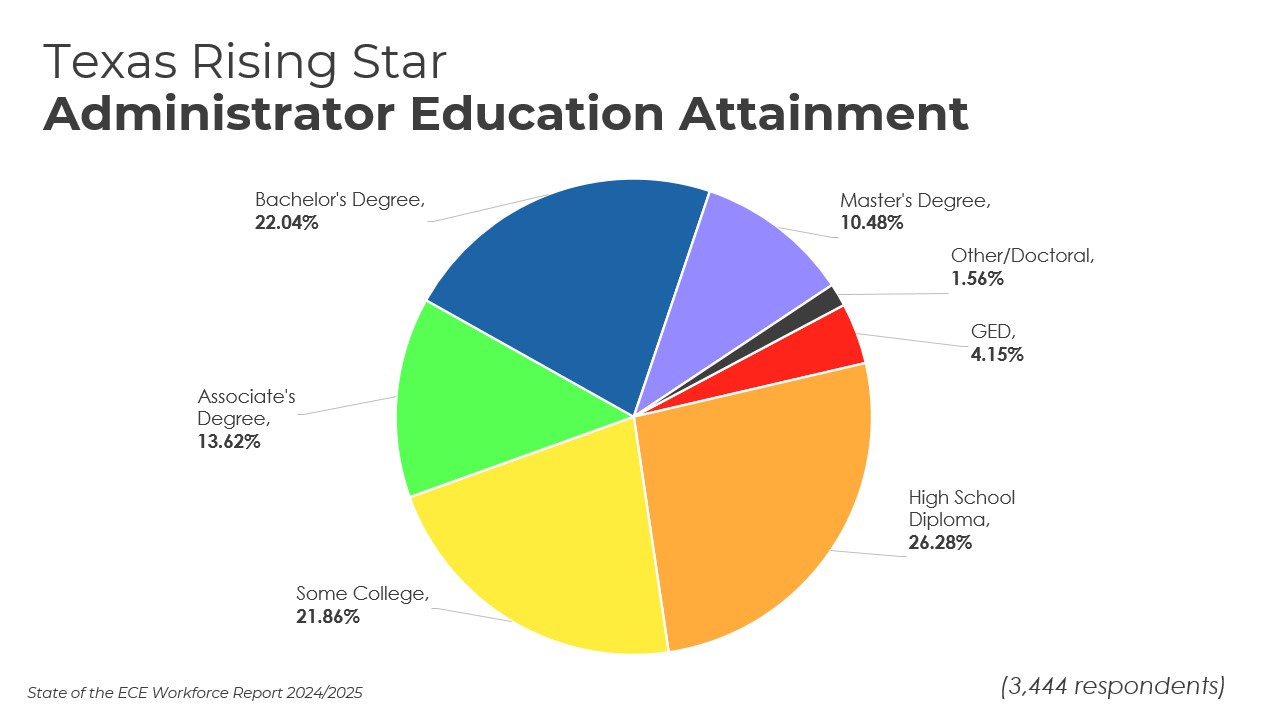
Among early learning program administrators participating in Texas Rising Star, reported educational attainment is higher overall. Nearly half of administrators (48%) report having at least an associate’s degree, a pattern that has remained consistent across prior years of reporting. The dashboards below display educational attainment data for professionals participating in Texas Rising Star.
Work Experience Data
TECPDS also houses data on the work experience of early childhood professionals. The dashboard below displays the number of years of experience reported by educators, administrators, and registered trainers. As of December 2025, 10,726 early learning programs were connected to the Texas Workforce Registry through linked administrators and educators. Work experience is one important dimension for understanding workforce quality, expertise, and retention, and can be examined alongside other characteristics across early childhood sectors.
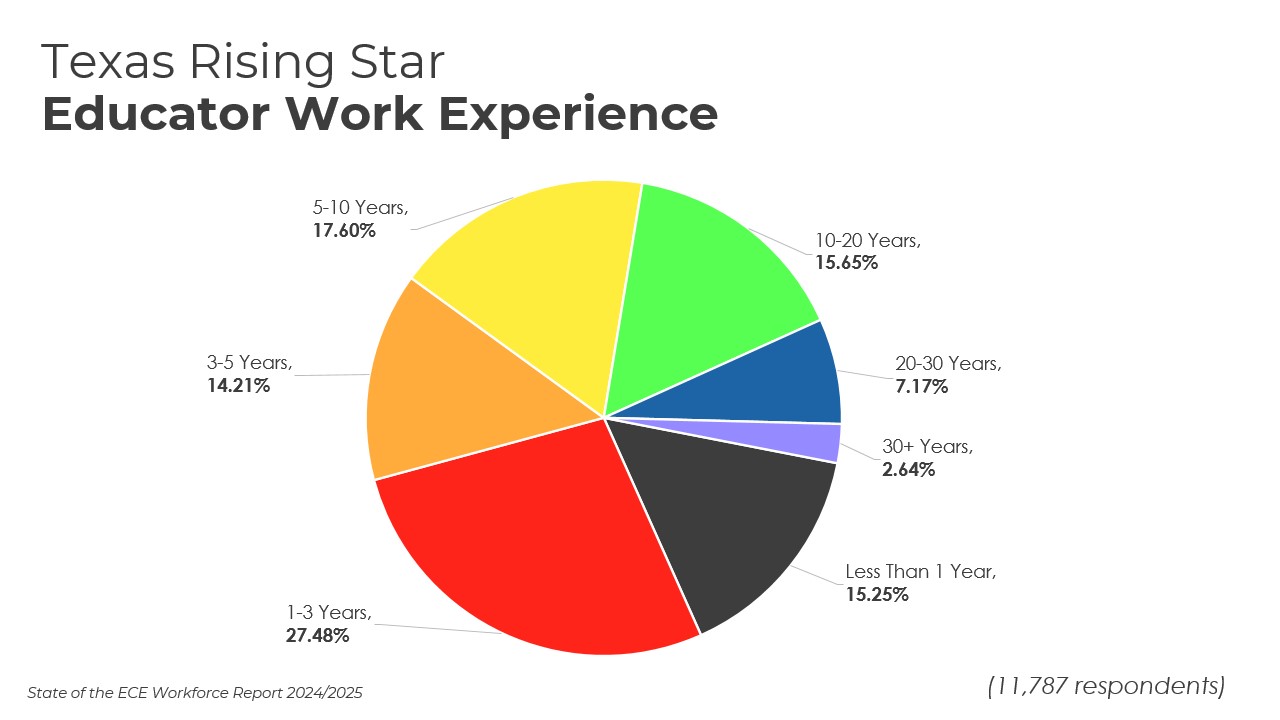
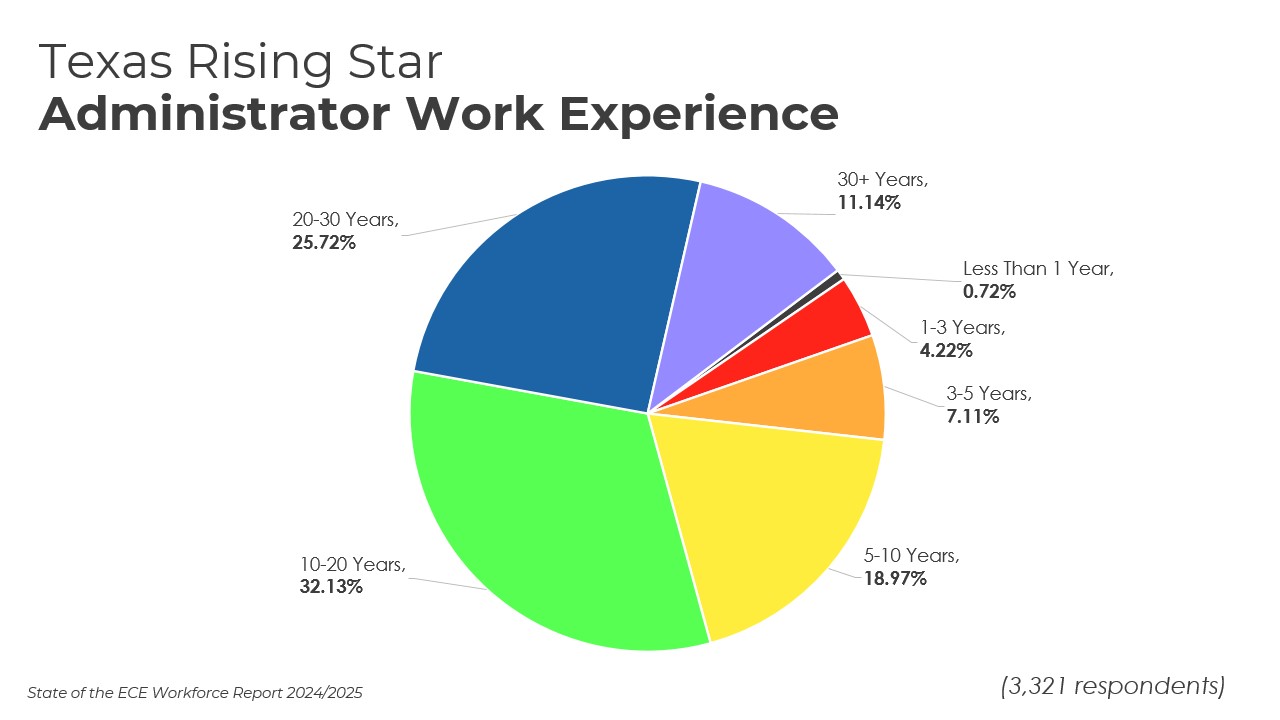
Across roles, administrators (such as center directors) report more years of field experience than educators, a pattern consistent with TECPDS reporting from prior years. The majority of administrators report 10-30 years of experience (32% indicating 10-20 years; 25% indicating 20-30 years), with the distribution heavily skewed towards more years than fewer. In contrast, the largest share of educators reports having 1-3 years of work experience (26%), with a more even distribution of years of experience. While these patterns are generally consistent with prior years, this data indicates the proportion of early-career educators has increased (25% compared to 21% in 2023), a signal that continued investment in high-quality training and workforce support is needed. Relatedly, registered trainers report the highest levels of experience, with 78% having at least 10 years of experience in early childhood. These findings are not surprising, as most early childhood professionals begin their careers in the classroom and may later advance into other roles.
Take some time to explore work experience in your area using the filtering tool!
Work experience among educators and administrators working in Texas Rising Star early learning programs mirror patterns across the broader TECPDS user population. Approximately 57% of educators working in Texas Rising Star programs have five or fewer years of work experience. This contrasts with administrators, who report much higher levels of experience distributed across the 10-20 years (32%) and 20-30 years (26%) categories.
Conclusions and Opportunities
The Children’s Learning Institute continues to champion TECPDS as a tool to support individual career advancement and overall workforce development, as well as the primary resource for understanding the characteristics of the early childhood workforce statewide. In 2025, TECPDS continued several projects aimed at improving the consistency and quality of workforce data available on the platform, including new functionality to support targeted data collections, facilitate timely user account updates, and provide stakeholders with more accurate and current aggregate workforce information.
The goal of this report is to share timely data that informs policy decisions and drives further research. The Texas Workforce Registry was originally built as a digital repository of early childhood career profiles; TECPDS has since expanded to offer programs, services, and resources to the workforce, including core competencies, links to quality trainings and trainers, and certificate generation at no cost. Over time, the system has continued to grow and help Texas understand workforce needs and drive investments in strategies that support its members. Leveraging TECPDS data can be one of the first steps toward supporting conversations on workforce improvement and strengthening data-informed reflection and decision-making in workforce development.
Each report of TECPDS data, along with related workforce data sources, provides a deeper understanding of the complex early childhood workforce and its individual members; however, this picture remains incomplete. To assemble a more accurate picture, continued engagement from early childhood stakeholders (including city and state agencies, local workforce development boards, trainers, and administrators) is essential. This engagement supports the use of TECPDS both as a tool for personal career documentation and advancement and as the state’s resource for learning about and planning for the early childhood workforce.
As Texas Rising Star and Child Care Regulation participation continues to expand statewide, TECPDS will remain a key career advancement resource for individuals while also using it to understand the unique qualifications and needs of this dynamic workforce.
Data Limitations
Please note that many TECPDS users hold multiple roles in the system, reflecting the broad range of experiences across the early childhood field; this limitation is potentially more impactful as users transition to more specialized roles. For example, a user may serve as a lead teacher, serve as an instructional coach, and be approved as a Registered Trainer. Certain roles (e.g., school leaders) or settings (e.g., public schools) may require specific education, experience, or skills that are reflected in this data. In 2025, TECPDS conducted several activities8 focused on consolidating duplicate accounts and streamlining account creation processes to support more accurate reporting.
The data is also affected by users enrolled in the statewide Texas Rising Star program. Currently, administrators of the Texas Rising Star early learning programs are the only users required to participate in TECPDS. As a result, a large share of complete data comes from this specific user group, which represents approximately 60% of child care programs9 but may not fully reflect the broader Texas early childhood workforce. Through ongoing collaboration with Child Care Regulation, participation in TECPDS is expected to continue increasing across additional workforce segments.
As noted throughout the report, our data is sufficient to begin telling the story of Texas’s current early childhood workforce. Continued growth in TECPDS participation, along with the integration of additional workforce data elements, will strengthen this understanding over time. Future enhancements may include new data fields that provide additional context, such as age, ethnicity, wage, and workplace benefits, to better understand how the early childhood workforce reflects and supports Texas’s growing child population.
Authors
- Yusra Ahmed, Ph.D.
- Vibhuti Bhavsar
- April Crawford, Ph.D.
- Tracy Anne Jones, Ed.D.
- Jennifer Lindley
Acknowledgments
Thank you to the faculty and staff of the Children’s Learning Institute for their support and guidance on the 2024-2025 State of the Texas Early Childhood Education Workforce Report.
Special thanks to the Texas Workforce Commission’s Child Care and Early Learning Division program leadership and staff for their ongoing support for TECPDS.
Suggested Citation
Children’s Learning Institute at The University of Texas Health Science Center at Houston. (2026). Texas Early Childhood Professional Development System: State of the Texas Early Childhood Education Workforce Report 2024-2025. Houston, TX.
Footnotes and References
- Educators were previously referred to as “practitioners” on TECPDS and in prior reports.
- The 2024-2025 report was produced after TECPDS completed several rounds of account clean-up to eliminate accidental duplicate accounts created by individual users in the past. This review improved the accuracy of the underlying account records used for analysis relative to previous reports. Account clean‑up included removing inactive accounts without activity or uploaded data and merging duplicate accounts where consolidation did not risk loss of valid career information.
- A small portion of (4.63%) users had more than one account in TECPDS at the time of reporting and were retained in the analyses because their career data may exist across multiple profiles. TECPDS is working with users to combine career data for possible duplicate accounts. Separately, to maintain a consistent analytic focus on classroom educators, approximately 6% administrators with an educator role and 1% Registered Trainers with an educator role are filtered out from educator-level analyses.
- https://public.tecpds.org/workforce-data/tecpds-career-pathway-study/
- Prenatal-to-3 Policy Impact Center, Vanderbilt University. (2023). Workgroup Recommendations to Inform the 2022 Texas Child Care Workforce Strategic Plan.
- U.S. Bureau of Labor Statistics (2025). Education pays, 2024. Career Outlook.
- Center on Education and the Workforce, Georgetown University. (2025). The Major Payoff: Evaluating Earnings and Employment Outcomes Across Bachelor’s Degrees.
- TECPDS began a process of reviewing and consolidating duplicate accounts created by users in 2025. These duplicate accounts are often created in error, and TECPDS consolidates a user’s information into a single account as part of our process. As a result, the data reported in this report provides a more accurate representation of workforce members.
- Children at Risk. (2025). 2025 Analysis: Child Care Deserts.